We want to create a long-term relationship of trust and health with parents and children
In the period of breastfeeding, there are various situations in which expressing breast milk is a useful, and sometimes the only solution. Some mothers never feel the need to express, others exclusively express breast milk and use it to feed their children. Expressing stimulates, maintains or increases milk production. Expressing can be done by hand or with mechanical breast pumps.
Expressing is a special skill that should be acquired in good time. With some practice and persistence, every mother can master this skill.
Why express breast milk?
- in the event of nipple damage or when breastfeeding is painful (despite the proper technique)
- to ensure good milk flow in cases of blocked milk ducts and breast infections
- for prematurely born infants and infants with low birth weight, until they are able to suckle by themselves
- to stimulate or increase milk production
- to maintain milk production if the child is sick and consequently too weak and exhausted to breastfeed
- when hospital conditions do not provide “rooming-in” and “Kangaroo Care”, or when hospital wards are far apart
- to maintain milk production while taking medication that is not compatible with breastfeeding and does not have a safe alternative
- during separation from your child (e.g. because you have gone back to work), in the case of the mother’s or infant’s hospitalisation
- to maintain milk production during certain diagnostic procedures
- when introducing complementary feeding, during separation from your child (meals containing mother’s milk)
- in the case of relactation (the process by which a woman who gave birth and did not initially breastfeed or breastfed for a short time, re-establishes milk production which had until that time ceased or decreased)
- in the case of increased milk production
Choosing how to express
The choice of milk expression method depends on the circumstances of the mother and child, healthcare staff recommendations and the mother’s personal preferences.
Therefore, the milk expression methods of a mother who is separated from her hospitalised child can differ significantly from those of a mother who expresses sporadically or on appropriate occasions.
The most widespread method is expressing by hand, as it does not require any kind of equipment: just the skill of the mother’s hands. It is therefore always recommended in hospitals as the first choice. Some mothers find expressing by hand more natural than mechanical expression, due to the pleasant feeling created by hands touching the breast skin, which can have a stimulating effect on the milk ejection reflex (when compared to contact with the plastic parts of a breast pump). In contrast, some mothers prefer mechanical expression as the more comfortable solution, since it is shorter and suitable in situations when the mother is unable to express manually (e.g. due to illnesses, such as arthritis, muscle weakness, etc.). Some studies suggest that expressing with a double electric breast pump is the most effective in increasing breast milk production.
Manual expression takes at least 20 to 30 minutes for one breast, while the double electric breast pump takes around 10-15 minutes to express milk from both breasts simultaneously.
Manual and battery-operated breast pumps require 10-20 minutes to express milk from one breast.
Milk expression requires a lot of patience, effort, love and support from one’s surroundings. The key to successful expression is developing the milk ejection reflex (the so-called “let-down” reflex). If you are just starting to express, try to relax and give yourself a few days to master this skill before you start questioning your ability to produce milk. If you truly feel you are not making progress, seek help!
When to begin expressing?
If your infant was born with low birth weight and you are starting to express in order to stimulate milk production, you should begin expressing within 24 hours of delivery – ideally six hours after the delivery (depending on your health condition).
If, in a period of 18 to 24 hours after the delivery, your infant is suckling unsuccessfully, it is necessary to use a double electric breast pump and express at least eight to 12 times (a total of 100 minutes) in 24 hours.
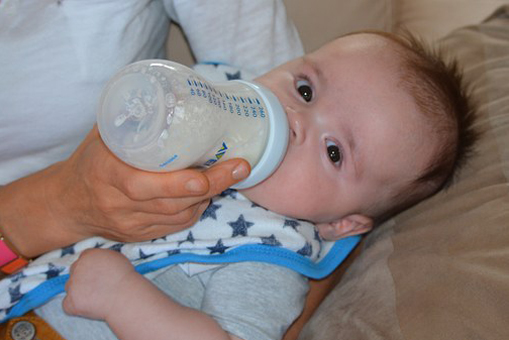
If necessary, expressed milk can be administered immediately after the expression, using alternative means such as spoons, syringes or cups. Avoid using a bottle to feed your child, except in special cases when this is the only way. Expressed breast milk can be stored in the refrigerator or freezer for future use. To store expressed milk, use special-purpose glass or plastic vessels, intended for breast milk storage. To freeze breast milk, use specially designed freezer bags which protect the contents from contamination. In addition to being impeccably clean, all equipment that comes into contact with the infant or breast milk must not contain the harmful bisphenol A. Manufacturers usually display the fact that their product is bisphenol-A-free on the packaging.
Before expressing:
- wash your hands!
- follow the manufacturers’ instructions on assembling and maintaining the breast pump
- dampen the breast before positioning the breast shield (the plastic part of the pump which is attached to the breast) to achieve better adhesion
- choose the appropriate breast shield size
- sit comfortably
- the nipple should be in the middle of the breast shield, moving freely inside the “tunnel” during expression
- the nipple should not “grind” against the sides of the breast shield
- when turning the breast pump on, set it to minimum; if necessary, gradually increase the settings during the expression
- expressing should not be painful; in the event of painful expressions, try to determine what is causing you pain and then repeat the procedure
- if you continue to feel pain, seek help
Choice and use of breast pumps
Manual breast pumps – most popular, relatively cheap and readily available
Bulb-style breast pumps, also called bicycle horn pumps
Rarely encountered in clinical practice, but mothers continue to use them.
Part of the rubber “bulb” is attached directly to the glass or plastic/polycarbonate part which is placed on the breast.
- squeezing the rubber part creates a vacuum and initiates expression. The vacuum is very difficult to control, which increases the risk of nipple and surrounding tissue damage.
- the most affordable type of breast pump, which can express a maximum of 15 ml of milk in one session. The plastic/glass part does not function as a container and has to be emptied frequently, which directly exposes the milk to contamination.
- although affordable and still widely accessible, they are a bad choice, regardless of the circumstances.
The most recent manual breast pump models operate on the principle of pressing, holding and releasing the pump handle
- this enables mothers to control both the cycle and the vacuum (by mimicking the infant’s suckling pattern)
- used for occasional expression; can be used when electric energy is not available
- not recommended for frequent use as they cause palm and wrist exhaustion; however, modern technology has developed models with special ergonomic traits which prevent exhaustion and can therefore be used even by mothers with small palms. They can be used by both left- and right-handed women, and their handle can be set in three different directions
- the gentleness, efficiency, individuality and simplicity of maintenance differ depending on the manufacturer
- when choosing a breast pump, pay attention to the available breast shield sizes; this is an extremely important factor, directly linked to successful expressing!
Electric breast pumps with battery backup
Small electric breast pumps, also called semi-automatic or mini electric
Use
- less motor power than medium and large automatic electric breast pumps
- equipped with a small electric motor which provides continuous suction and release
- suitable for occasional use if you already have stable milk production
Pros
- small, light and easy to transport
- some models are silent
- when powered by batteries, they do not require sockets
- suitable for travelling
Cons
- some models are noisy during expression
- due to small motor capacity (short-term warranty for the motor) they can only be used 5 – 6 times a week
- excessive use causes the motor to “overheat”, which terminates the warranty
- manufacturers recommend single-person usage
- inner membrane cannot be replaced, which makes it a possible source of infection
- beware of purchasing used breast pumps – they often have mould in difficult-to-reach places and are difficult to maintain!
- models that achieve only 30 cycles per minute or less can damage the nipple or surrounding tissue, as the tissue is exposed to vacuum stimulation for a longer time
- rapid battery consumption (additional expense)
- milk has been known to drip into the motor
Medium electric – cylinder/piston pumps or diaphragm electric pumps – independent or part of an expanded set (portable)
Use
The motor is less powerful than motors in large automatic electric breast pumps, but no less effective (applies to the most recent models)
- suitable for women who have already established stable milk production, in cases of daily expressing
- generally speaking, it achieves less than 220 mm Hg of vacuum (older models; newer models achieve up to 330 mmHg) and between 30 and 60 cycles per minute
- a great help to mothers who express at home and carry the expressed milk to the hospital, as well as mothers who wish to express and feed their infant with their expressed breast milk
Pros
Lighter than large breast pumps and easier to transport.
- in the case of battery backup, the pump does not need a socket to work
- mostly easy to use (depends on the producer)
- it comes in a portable bag or backpack with a built-in or separate cooler which enables the safe storage and transport of the expressed milk (depending on the manufacturer and containers)
- independent speed and vacuum control enables mothers to adjust the speed to their individual comfort levels.
This possibility can improve the milk-release reflex in some women.
Some models do not have this option as the speed is set, and only the vacuum can be adjusted.
Depending on the manufacturer, the pump is also available as a double set, which cuts the expression time in half and increases the possibility of maintaining breastfeeding for a longer period of time.
- cylinder/piston electric breast pumps use a closed system, so the breast milk cannot reach the motor
- cylinder/piston electric breast pumps are safe for multiple users (hospitals, rental)
- operates silently
- some diaphragm electric breast pump models provide the “hands free” option
Cons
- price
- not widely available
- some models cannot be charged inside a vehicle or do not come with renewable batteries; some provide this option but only at additional cost
- manufacturers recommend diaphragm electric breast pumps for single-person use
- in diaphragm electric breast pump models, the inner membrane cannot be replaced and as such represents a potential source of infection
- some manufacturers are far away from the retailers (spare parts, guarantee, replacement), so it is important to make inquiries prior to purchase
Large electric cylinder/piston breast pumps – for hospital use/rental; “Hospital Grade” single/double
Use
- strong motor intended for non-stop work
- most efficient for increasing or maintaining breast milk production, especially if breastfeeding was not possible for a longer period of time (e.g. due to separation of mother and child after birth, hospitalisation, use of medication…)
- relactation
- this type of pump achieves 220 mm Hg of suction pressure (old models); newer models achieve up to 330 mm Hg and 48 to 60 cycles per minute, which is close to infant suckling
- breast pumps with higher speed per minute tend to be more efficient than those with lower speed
Pros
- the most efficient type of breast pump
- easy to use
- independent speed and vacuum control enables mothers to individually adjust it to their own levels of comfort
- some mothers notice better results if they have the possibility to change settings during expression
- possibility of using a double set which cuts the expression time by half and increases the possibility of maintaining breastfeeding/milk production for a longer period of time
- closed system which prevents contamination (breast milk cannot reach the pump motor)
- safe for multiple users (hospital, rental)
- silent work
It is important to note that in addition to choosing the right breast pump, you should also pay attention to the accompanying parts which come with the pump (these vary depending on the manufacturer), e.g. breast shields in different sizes, 24mm being the standard size for most well-known manufacturers.
New and modern technologies provide mothers with a large number of different breast shields (22, 24, 26, 28, 31 and 36 mm in diameter), as well as different combinations, depending on the mother’s (or healthcare staff’s) individual needs (e.g. an electric breast pump set which can turn into a manual pump if necessary, and vice versa).
Additional equipment also includes the popular “soft” insert, which in some models is meant to merely “soften” the part of the breast shield that is attached to the breast, while in others it assumes a more active role of massaging the breast(s) during expression.